

Coming Out in Putin’s Russia: A Conversation with Aleksandr Voronov
We recently had the chance to spend some time with Russian LGBTQI+ activist Aleksandr Voronov on his visit to Washington, D.C. in early May. Aleksandr — Alex, to his American friends — is the Executive Director of Coming Out, an NGO that provides legal, psychological, and other direct services to Russia’s LGBTQI+ community. Coming Out also conducts research on Russian attitudes on sexual orientation and gender identity; supports families and friends of Russian LGBTQI+ community members; and builds working partnerships with allies in the country’s legal, business, media, mental health, and other professional spaces.

Broadly speaking, Alex explained, Coming Out works to make everyday life better for LGBTQI+ Russians, to identify access points to change in Russian society and culture, and to find allies and make them into agents of change, all on the road to equality.
Alex, who has been based in Vilnius, Lithuania, since shortly after Vladimir Putin ordered the invasion of Ukraine last year, shared his story of joining Coming Out in early 2020. A social worker in Saint Petersburg working with families, people living with HIV, and unhoused persons, Alex was looking for a career change right as Coming Out was hiring for its brand-new position of Monitoring and Advocacy Officer. He came on board at the beginning of April 2020, just as Russia was implementing COVID-19 lockdowns.
For the Saint Petersburg-based organization, this turned out to be an unexpected blessing, as Coming Out shifted to online operations — allowing it to serve the LGBTQI+ community across Russia’s eleven time zones, not just in its home city. This shift allowed Coming Out to not only to survive but to grow, even as Russian authorities declared the NGO to be a “foreign agent” and then as Coming Out’s leadership left the country following the beginning of the Ukraine War. As Alex noted, yes, being labeled as a “foreign agent” led some Russians to stop volunteering with Coming Out, some businesses and other partners to end their collaborations with the organization. But Alex — who was promoted to serve as Executive Director in late 2021, right before the “foreign agent” ruling came down — and his leadership team steered Coming Out through this pair of existential crises to survival and expansion of its services, even from outside Russia’s borders.
As one might expect, the Ukraine War and the series of homophobic and transphobic laws pushed from the Kremlin have made life challenging for Russia’s LGBTQI+ community — though not always in ways the West might expect.
The escalating mobilization for a war originally planned to take just a few days carries particular implications for the LGBTQI+ community, notably in prohibiting citizens identified as male on official documents from leaving the country. At the same time, the Russian state is also proposing to make it more difficult for citizens to officially change their gender markers on such documents. While the implementation of the new policy is just kicking in, it may very well add to wartime challenges facing transgender Russians, whose access to gender-affirming hormone therapy has been disrupted by the conflict and whose ongoing economic marginalization has only escalated due to the state of the Russian war economy. And a new bill in the Russian parliament may also shut down private centers for transition-related care, making it even more difficult, if not impossible, for many transgender Russians to seek ongoing treatment and transition support.
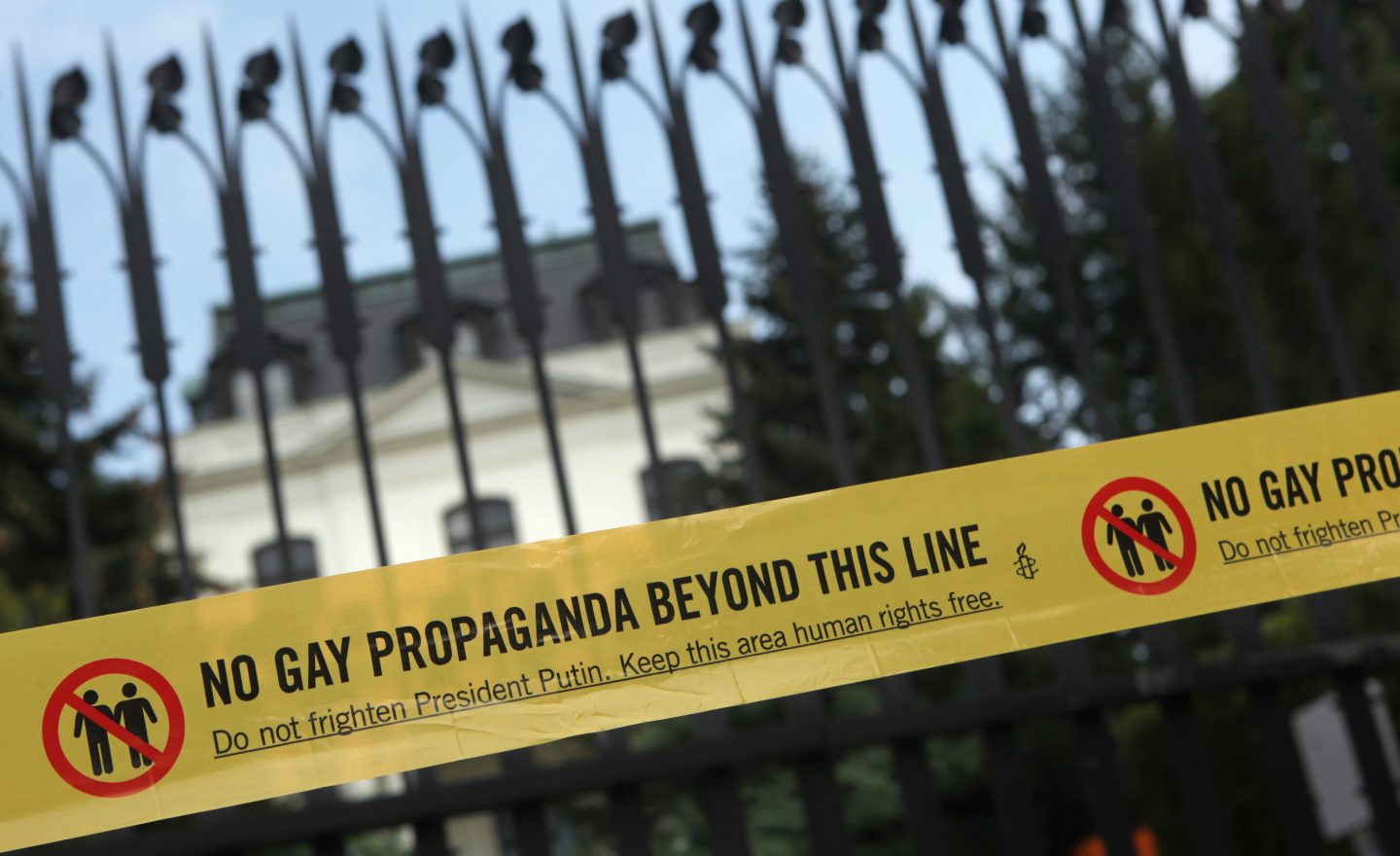
For Vladimir Putin, “the war in Ukraine and his country’s decade-long assault on LGBTQ rights are two sides of the same coin,” argues Foreign Policy analyst Amy Mackinnon. “Scapegoated in the state media and portrayed as agents of Western influence, Russia’s queer community was the canary in the coal mine of the wider offensive against the West that was to follow when Putin returned to the presidency in 2012.” Both the original 2013 anti-LGBTQ “propaganda” law and the expanded law passed late last year point to the importance of this tool in the arsenal Putin is wielding both against the West and the against the very concepts of human rights and civil society.
In an op-ed last week, Graeme Reid, Director of Human Rights Watch’s LGBT Rights Program, likewise framed the expanded “propaganda” law as a move “to consolidate conservative support at home and position Russia as the defender of ‘traditional values’, in opposition to ‘the west’.” The 2013 law itself “has been at the heart of Russia’s domestic politics and foreign engagements — a symbol of its wholesale rejection of universal human rights. Its extension is but one further step in representing LGBT+ rights as a foreign threat and a Trojan-horse ‘enemy within’,” Reid argues. Reid and others have long noted how Putin has this rhetoric to restore Russia’s influence in the traditional Soviet sphere of influence, from Viktor Orban’s Hungary and Duda’s Poland to the authoritarian regimes of Central Asia. Now, Russia is exporting both military helicopters and anti-LGBTQI+ legislation to Uganda, among other partners in the war on democracy and human rights.

For Alex, the importance of the anti-propaganda laws at home lies less in their direct prosecution, as that has been relatively infrequent and mostly haphazard. Instead, as documented by the recent research Coming Out conducted in partnership with Sphere, another LGBTQI+ Russian organization, the major impacts of the laws for everyday citizens are psychological stress and self-censorship. That is, the fear of bringing up LGBTQI+ issues is real. And the infrequent, almost arbitrary use of the law in unpredictable ways magnifies the psychological stress, because it’s not easy to predict when the government will bring charges. This keeps the community on edge, and that’s the point.
From the outside, the Russian system looks more like a system than it actually is. What Russians face is repressive but not predictably so, and that uncertainty adds greatly to the daily stress. Indeed, the randomness of how anti-LGBTQI+ laws are used is central to the repression: when you might or might not be punished for your actions, there’s no way to plan, and the tendency, Alex explained, is to not say anything, not share anything on social media, out of an understandable abundance of caution. Also, while some dating apps have left Russia, there hasn’t yet been a full-scale push by the authorities to close LGBTQI+ bars and other commercial venues — but that potential loss of critical social space could very well still happen. Indeed, indications suggest that’s coming.
One particular danger that the anti-propaganda laws pose for LGBTQI+ Russians and their allies is grounded in police corruption. For police officers trying to meet quotas of cases prosecuted — whether to get more money, a promotion, or more stars on their uniform — winning a conviction for propaganda is far easier than investigating and prosecuting a case for murder or burglary, for example. Rather than conducting an extensive investigation, winning a propaganda conviction only requires going online, finding and saving a questionable post, and showing it to the court.
For Alex, there’s an opportunity in the general disinterest in LGBTQI+ issues on the part of Russians at large. As Coming Out’s research has shown, Russians don’t necessarily believe in their current political system, but — as they focus on paying their rent, making ends meet, and staying out of poverty — they want to fit in and survive. This harkens back to life under the oppressive Soviet system. Stability and order are as central to Russian political culture as freedom and liberty are in American politics. So, as Alex explained, if the state warns that Westerners with “non-traditional values” (a phrase whose power lies in its vagueness) are endangering that stability, to upset the “don’t ask, don’t tell” order of daily life, that’s an effective message.
Coming Out’s research also suggests that though the anti-propaganda laws have been crushing for activism in Russia, along with the brutal state crackdown on all dissent since the outbreak of the war, LGBTQI+ Russians are not experiencing homophobia as a constant factor in their everyday lives. In Saint Petersburg and Moscow, being queer is becoming normalized, especially for younger people (although LGBTQI+ people are far less likely to feel safe coming out in other parts of the country). “So, while activism isn’t really happening right now, people are living their lives,” Alex noted.
As we wound down our conversation, Alex brought up the urgency of not conflating the Russian people with the Russian government. He pointed to the large protests last year — and to the violence and cruelty of the state in punishing demonstrators — as evidence that many Russians would like to change the situation they face but don’t currently have to tools to do so. The lack of independent media also remains a key factor – though, as Alex reminded me, the American example shows that access to a broad range of viewpoints doesn’t foreclose support for authoritarian politicians.
As Alex returns to Vilnius, as the Coming Out team continues to advocate for LGBTQI+ Russians, and as Russia’s war continues in Ukraine with no end in sight, the fight against the various repressive tactics of authoritarianism includes supporting our LGBTQI+ colleagues working in Russia and elsewhere around the world on the frontlines of the fight for democracy. The fight for LGBTQI+ rights is a fight for democracy and free civil society, and there is no clearer example of that than Russia.